FIGHT ON!
Allies in survival. Rivals for the score. No one knows until the end.
Design pillars
Outnumbered, never cheated
The horde is the fantasy. Every hit that lands has to be one the player could have read.
One tower, many worlds
The arena stays constant so the biome can change everything around it — sightlines, cover, mood.
Allies with a secret
Players survive together and score apart. Cooperation is real; so is the tally at the end.
The player fantasy
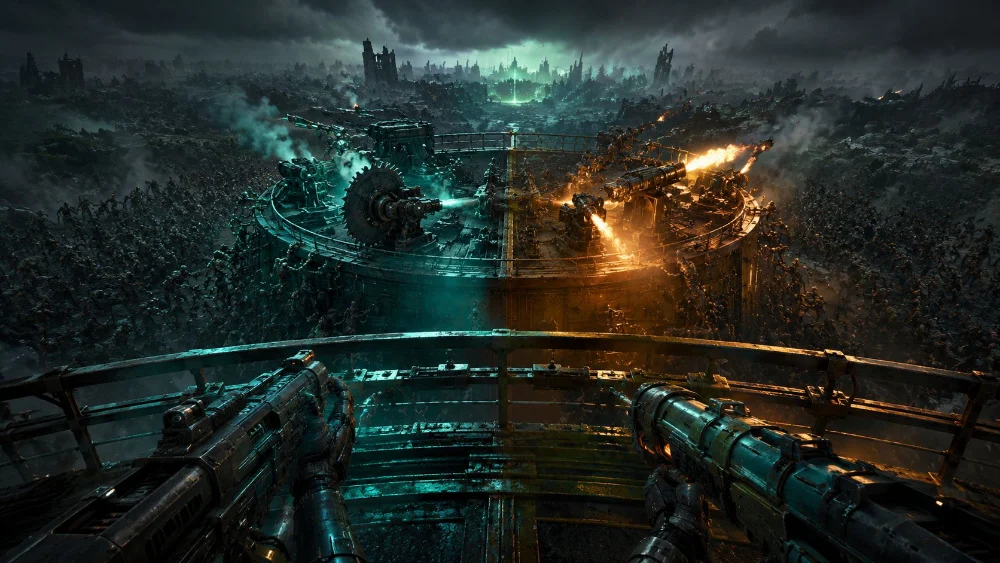
You are on top of the last standing structure, and everything below wants up.
The tower is the whole world: a firing platform, a wall, a thing that can be climbed. The player reads the field, picks a side of the rail, and commits. Enemies do the same — once they see you they do not disengage.
Pressure comes from numbers and from the clock. Relief comes from a clean parry, a good draft, and holding one more wave than the last run.
Systems breakdown
Nine systems running in the current build.
Telegraph colour language
Green windups are parryable and reflect projectiles. Red and purple must be dodged or blocked.
Poise & stagger
Poise at zero staggers. A parried green windup becomes a stun. Both interrupt any state.
Melee token arbitration
Only token holders may commit. The rest circle and wait, so a crowd never gangs up unfairly.
Eight enemy archetypes
Rusher, brute, ranged, chaser, shield, armed shield, elite overlay, multi-phase boss.
Enemy climbing
The tower is scalable. Height buys time, not safety.
Draft & upgrade
Between waves players draft upgrades — the roguelite spine of a run.
Hidden score
Everyone cooperates to survive. The ranking only resolves at the end.
Tower movement
Traversal around the rail — positioning is the primary defensive tool.
LAN multiplayer
Local network play, tested with four clients on one arena.
Enemy AI — the FSM
Ten authored state diagrams: one shared parent flow, seven archetypes, an elite overlay and a boss.
Every enemy runs the same parent loop and delegates its attacks to an archetype sub-machine. The loop exists to solve one problem: a crowd that feels relentless without ever becoming unfair. A token decides who may commit, and everyone else keeps pressure by circling.
Archetypes mix green and red deliberately so the player cannot spam a single answer.
Elites inject a signature ability into the base machine rather than replacing it — one overlay, every archetype.
Level & arena design
One arena shape, four worlds. Keeping the tower constant means the biome carries the variety — approach lanes, sightlines and silhouette read differently in a ruined city than in a flooded swamp, without retraining the player on the space.
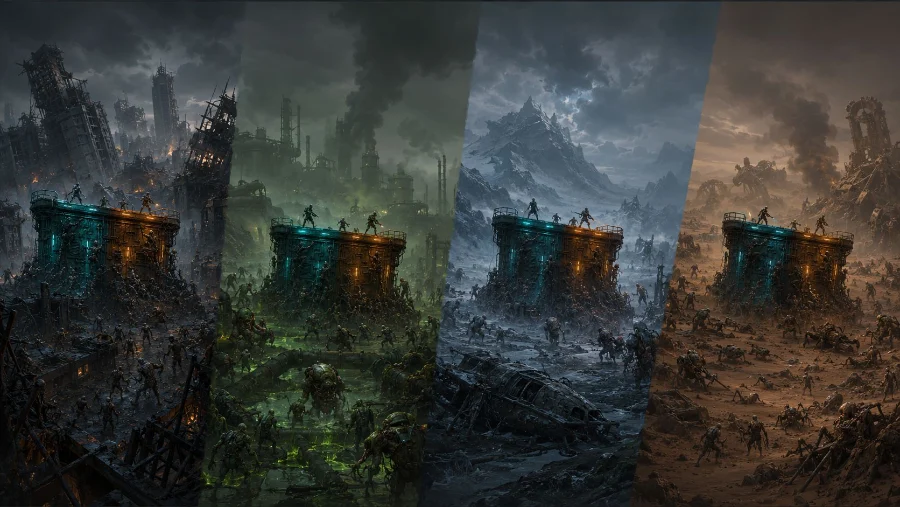
Dense cover, short lines of sight, vertical approach.
Slow ground, open sightlines, crowds arrive together.
Long reads, wrecks as cover, low contrast targets.
No cover at all — pure spacing and timing.
Draft & upgrade economy
Between waves the run branches. Players draft from a limited offer, which means the build is decided by what the arena has been doing to them, not by a menu memorised in advance.
Because score is hidden until the end, a draft is also a social read: take the pick that saves the group, or the one that wins the tally.
Tools & pipeline
Blueprints
Niagara · Materials
Wave & poise tuning tables
Sequencer for tells
Per-archetype isolation arenas
Parry-window pass on each tell
The diagrams are the source of truth. Each archetype is specified on its own page before it is built, so a behaviour change is a diagram edit first and a Blueprint edit second — and the parent flow only has to be solved once.
Built vs designed
What runs today, and what the design is aimed at.
The slice is deliberately flat. Proving the loop reads and the crowd stays fair is cheaper on a monitor than in a headset.
Want the build, the diagrams, or a walkthrough?
Happy to screen-share the slice and talk through why the token system exists.